Why Renewable Diesel Is Harder Than It Looks, and Completely Worth It
Aviation gets the headlines, but diesel gets the volume.
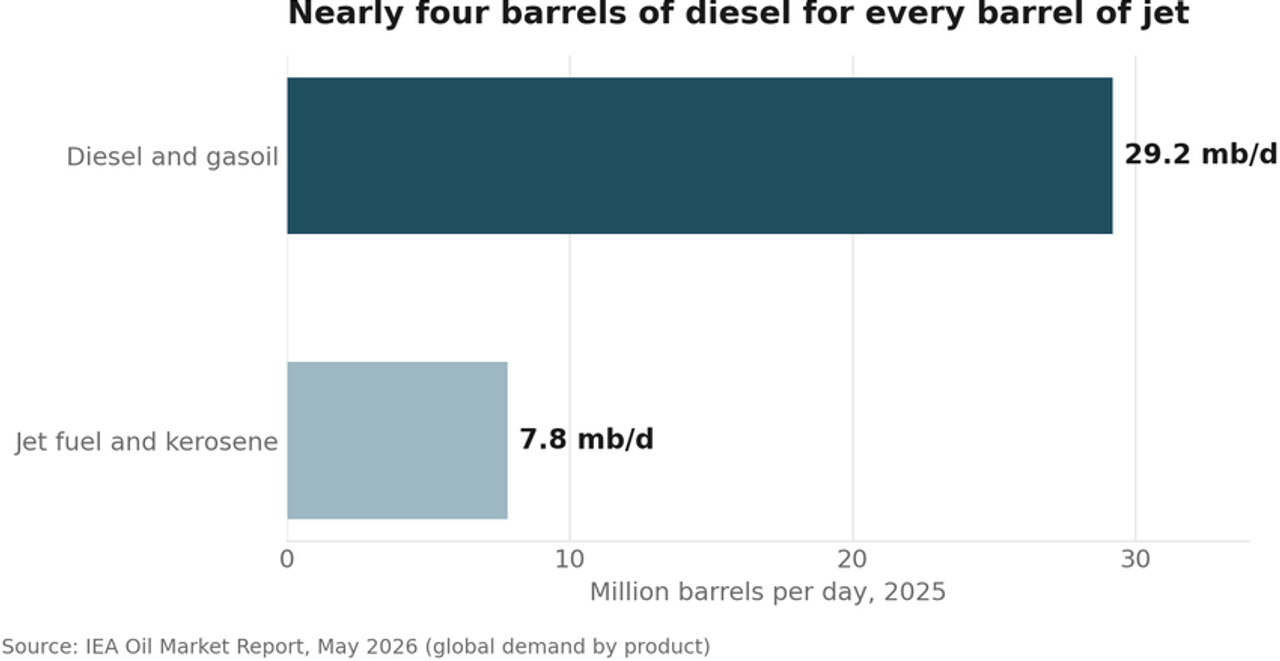
In 2025, the world consumed 29.2 million barrels of diesel and gasoil a day, compared with 7.8 million barrels of jet fuel (source). Nearly four barrels of diesel for every barrel of jet.
Aviation has received enormous attention as a difficult sector to decarbonize, and rightly so. But diesel powers an even broader collection of things that are not especially easy to plug into a wall: heavy trucks, trains, ships, mines, farms, construction equipment and backup generators.
The cloud, it turns out, also requires quite a few diesel engines on the ground. Diesel-generator capacity serving data centers nearly tripled between 2018 and 2024.
The result is a strange imbalance. Diesel is consumed at enormous scale, much of that demand will be difficult to electrify quickly, and yet its long-term decarbonization options receive a fraction of the attention devoted to aviation.
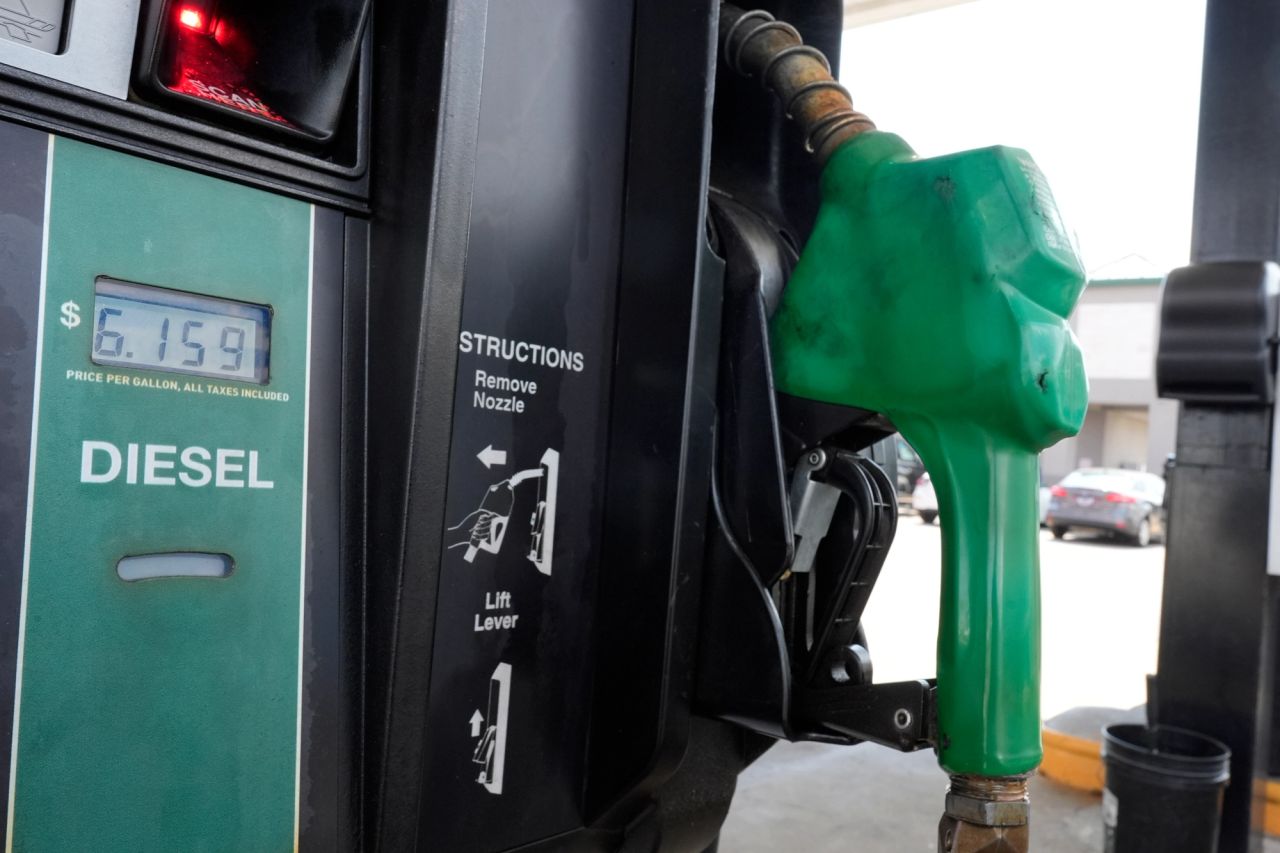
This dynamic is more timely than ever since, at the time of this writing, the price of diesel fuel in the U.S. has just exceeded $6/gallon – for the first time ever – which is notable to all of us given how much it is woven into the global economy. For reference, the current national average is a more than 60% increase just since February (source).
Why diesel still matters
The conventional wisdom is that aviation needs sustainable liquid fuel because aircraft cannot run on batteries, while ground transport eventually will. That is broadly true for passenger cars, and it gets much more complicated once the vehicles become heavier, travel farther, run around the clock, or work a long way from the nearest substation. Battery-electric trucks are growing quickly in China and far more slowly in Europe and the United States, and rail, mining, heavy equipment, and backup power each come with their own operating constraints (source).
Electrification will matter. But replacing every diesel engine is a very different proposition from replacing a commuter car, and a large installed base of equipment will need liquid fuel for years to come. The question is what kind, and here it helps to separate two things that usually get lumped together.
Renewable diesel, also called HVO, is made from fats and oils: used cooking oil, animal fats, vegetable oils. Synthetic diesel starts somewhere else entirely. Carbon dioxide and hydrogen are converted into syngas, which is then built up into hydrocarbons that behave like conventional fuel. Both can replace petroleum diesel in an existing engine, and their constraints are very different.
Renewable diesel has a feedstock problem
Renewable diesel is commercially established and works well in the engines already on the road. Its problem is not the fuel, it’s what the fuel is made from.
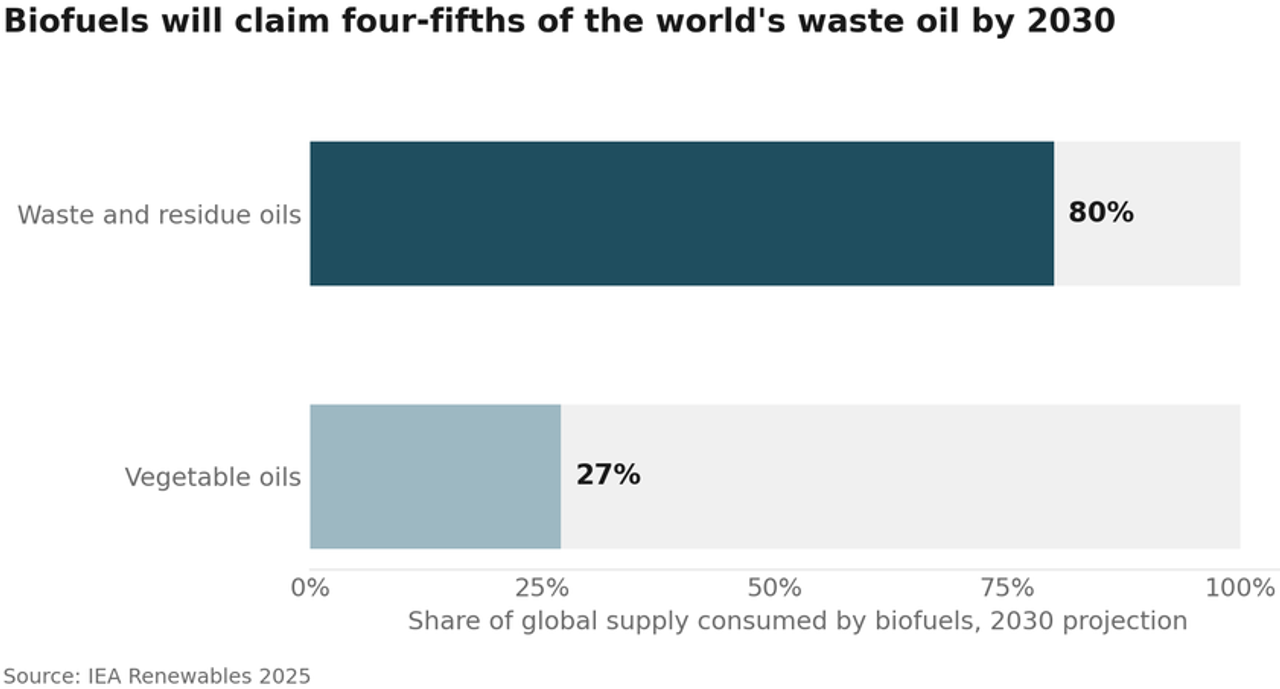
The same fats, oils, and residues that go into renewable diesel are also the primary feedstock for today's sustainable aviation fuel, so the two industries increasingly compete for one finite resource. The IEA projects that by 2030 biofuels could consume 27% of the world's vegetable oil and 80% of its waste and residue oils (source). Those numbers matter because waste oil is not something the world can manufacture more of when demand rises. There are only so many fryers.
Every ton of cooking oil that becomes truck fuel is a ton that does not become jet fuel. Two markets, one feedstock.
Synthetic diesel moves the bottleneck upstream
Synthetic diesel avoids the lipid constraint because its carbon does not have to come from a crop or a fryer. That does not make it easy; rather, it makes it hard in a different place.
The chemistry is well established: syngas, a mixture of carbon monoxide and hydrogen, is converted through Fischer-Tropsch synthesis into liquid hydrocarbons, a process that has run commercially for decades. Unfortunately, syngas does not come with a "diesel" button. Fischer-Tropsch produces a whole range of hydrocarbons, from light gases up to heavy waxes, and the producer has to design the synthesis and upgrading steps to steer that output toward the products it wants to sell.
The fuel that comes out has properties petroleum diesel can only envy: very high cetane, almost no sulfur, very low aromatics. Its lower density means that in Europe neat paraffinic diesel falls under a separate fuel standard rather than conventional EN 590, while in the United States it can be formulated to meet ASTM diesel requirements (source). These are manageable production and specification issues, and they are not why synthetic diesel has historically been expensive.
The harder problem comes earlier. As mentioned in our recent article “The Real Cost of SAF: Why the Unit Economics of Feedstock Will Decide Which Approach Replaces Fossil Fuels,” to make synthetic hydrocarbons at all, a producer needs low-cost carbon dioxide and hydrogen, and neither has been cheap: conventional direct air capture runs $600 to $1,000 per ton of CO₂, and renewable hydrogen costs $4 to $6 per kilogram. By the time those inputs become syngas, most of the economics of the finished fuel have already been decided. Synthetic diesel and synthetic jet fuel share the same problem, which is getting economically to the common building block.
One front end, two fuels
That shared problem is what makes diesel interesting for us. In our deep dive article “There Isn't Enough Used Cooking Oil in the World to Scale SAF,” we described how our unique process captures carbon dioxide directly from ambient air for below $50 per ton, roughly a tenth of conventional direct air capture, and combines it with water and renewable electricity to produce syngas. From there, established synthesis and upgrading steps can turn that syngas into jet fuel or diesel. The expensive upstream problem does not have to be solved twice.
A plant built around a common syngas platform can adjust its product slate to demand, economics, and policy, which matters because the markets for jet fuel and diesel rarely move in lockstep: aviation is developing dedicated synthetic-fuel mandates, road-fuel incentives vary considerably by country, and in the United States the same clean-fuel credit applies to both. For a producer, the ability to serve more than one market is an option worth having.
For a buyer, the proposition is simpler. A railroad, a mine, a fleet, or a data-center operator that cannot readily electrify needs a fuel that works with the equipment it already owns, without depending on a feedstock pool that gets scarcer every time another renewable-fuel plant comes online.
The good news for both SAF and Diesel
Sustainable aviation fuel deserves the attention it gets. Diesel is a parallel challenge that is easier to overlook because so much of the machinery that burns it sits in the background of the economy.
The good news is that these two problems do not require two different solutions. If low-cost syngas can be produced at scale, the same pathway can supply jet fuel where aviation needs it and diesel where electrification does not reach.