There Isn’t Enough Used Cooking Oil in the World to Scale SAF
Here’s a statistic most people would not associate with aviation: the world is running short of used cooking oil. Restaurants and food plants generate the stuff constantly, and somehow demand has outrun supply. That shortage is now one of the hard limits on how much sustainable aviation fuel (SAF) the industry can actually make.
A new assessment from Washington State University put numbers to it. Even in its optimistic case, the U.S. reaches about 2.1 billion gallons of SAF a year by 2030, short of the 3-billion-gallon federal goal and considerably lower under less friendly conditions.1 The study’s lead author, Kristin Brandt, has a line worth consideration: “Announcements are not the same thing as fuel.”2
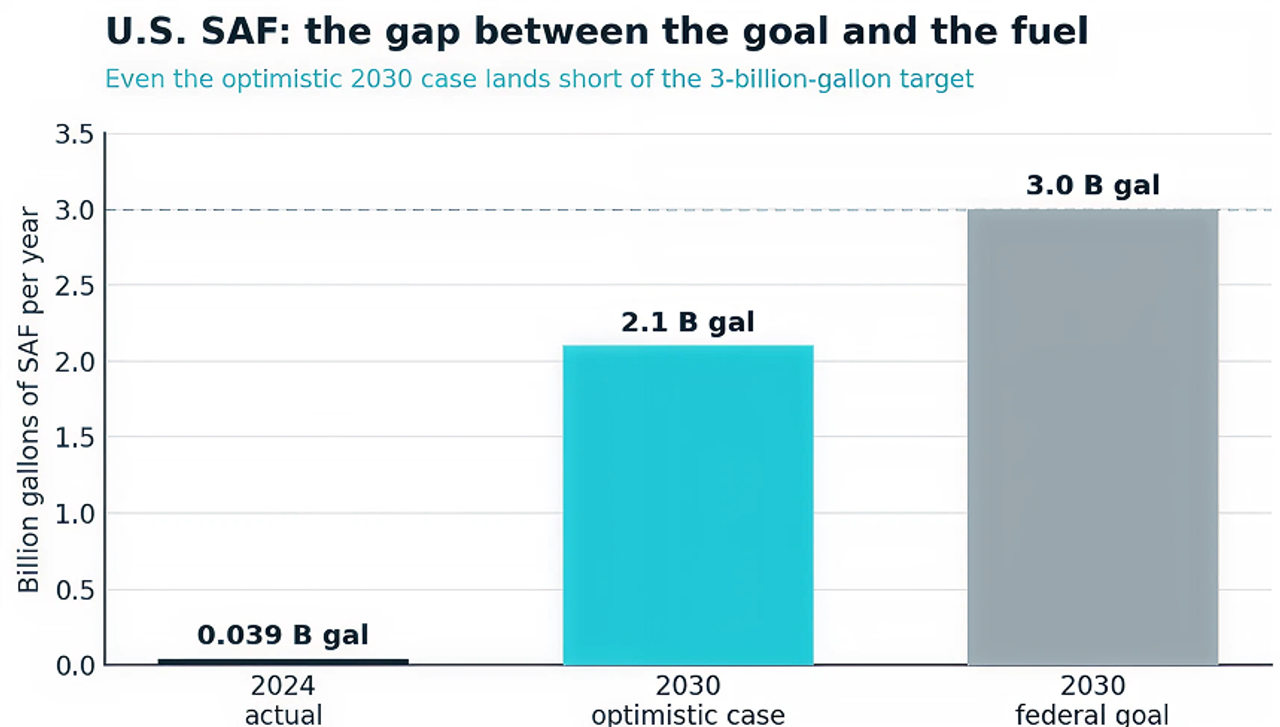
The 2024 starting point is a rounding error against the 2030 target, and even the optimistic projection falls short. Data: Brandt et al. (2026), via Earth.com.
The workhorse has a ceiling
Almost all of that SAF comes from a single process called HEFA. Short for hydroprocessed esters and fatty acids, HEFA upgrades waste fats and oils into jet fuel by adding hydrogen. It’s mature, comparatively cheap, and accounts for roughly 80% of current and near-term SAF capacity.3
Maturity isn’t the problem in this case – supply is. The industry has spent years and billions perfecting the technology to turn raw material into fuel, and the technology mostly works. What it doesn’t have is enough raw material. That’s the real shape of the SAF challenge today: a technology surplus sitting on top of a feedstock deficit.
The math doesn’t close
This is where optimism meets arithmetic. To hit the 2030 HEFA projections, the U.S. would need about 14.2 million tons of lipid feedstock a year. In 2022, total lipids going into every biofuel came to roughly 10.2 million tons, and aviation was barely a rounding error in that number. The gap is already around 4 million tons before SAF scales at all, and closing it would mean growing the entire lipid supply by something like 54% on a six-year clock.4
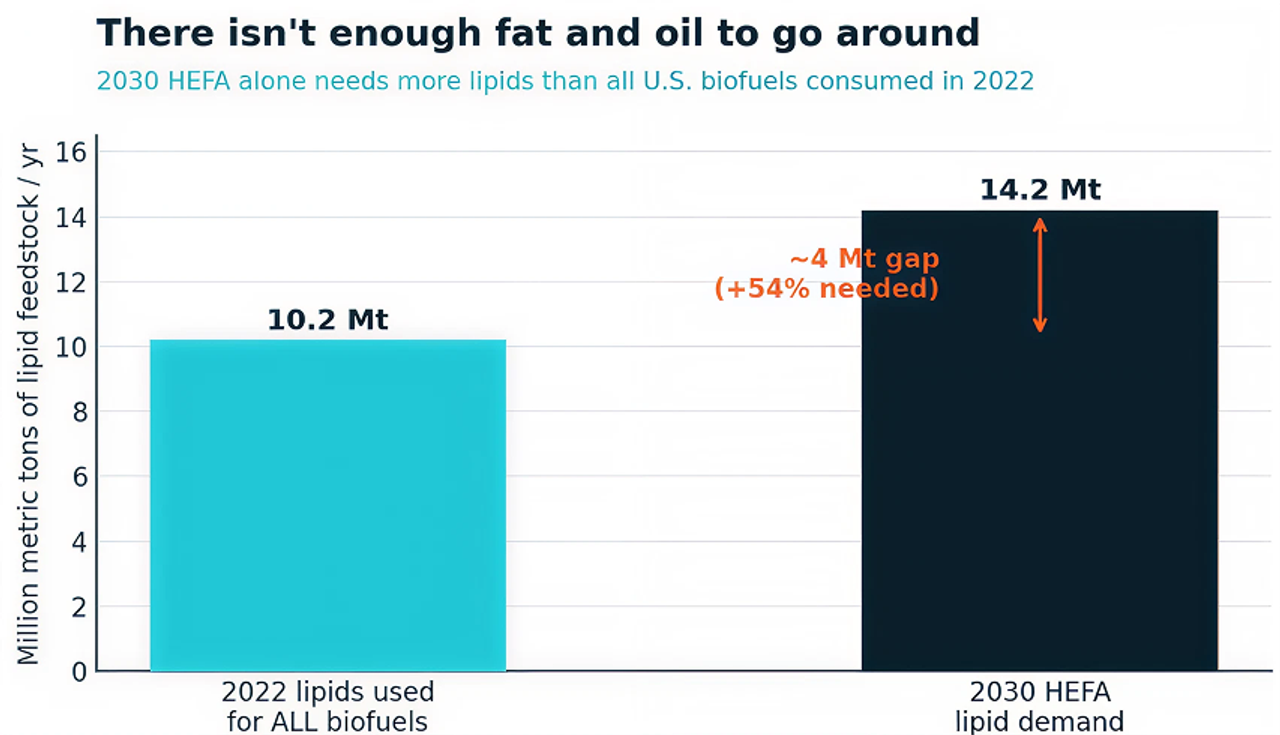
Aviation’s 2030 feedstock appetite outruns what every U.S. biofuel combined consumed in 2022. Data: Brandt et al. (2026).
Used cooking oil (UCO) shows the squeeze most clearly. The U.S. doesn’t collect nearly enough of it at home, so it imported roughly 2.8 billion pounds from China in 2024 just to cover the gap. Europe burns through about eight times the UCO it collects domestically.5 Add to that the import lifeline is fragile. Those Chinese volumes are now under EPA investigation, after shipments labeled as used cooking oil turned up cut with virgin palm oil.6 A feedstock you have to police at the border is not one you want to build an industry on.
Two traps, and neither is temporary
It would be one thing if this were a passing supply hiccup. But the reality is that it’s not because two structural problems sit underneath it.
The first is food versus fuel. Waste oils are finite by definition; you can only fry so much. Scaling past them means turning to soybean and other crop oils, which pulls feedstock into direct competition with the food supply and drags the fuel’s carbon intensity back up.
The second is quieter and arguably worse. The same fats and oils that make SAF also make renewable diesel for trucks, and under current U.S. policy, diesel is frequently the more profitable choice, so even when the feedstock exists the economics pull it toward the road and away from the runway.7
Layer on the build-out reality, where about half of announced renewable fuel projects never come online and the ones that do average four years from announcement to production with another year and a half of delay on top, and the distance between a press release and a fuel truck only grows.8
Not everyone frames it this way. IATA argues the nearer-term bottleneck is technology rollout rather than feedstock, and that expanding co-processing at existing refineries can buy some headroom.9 That’s a reasonable read. But buying headroom is the whole tell: these are ways to ration a scarce input, not to escape the scarcity.
Whoever solves feedstock wins
Step back and the picture gets simple. Every pathway, whether HEFA, alcohol-to-jet, or power-to-liquid (PtL), can turn carbon and hydrogen into jet fuel. The chemistry is solved. The contest is over inputs, over who can source millions of tons of carbon and hydrogen, in one place, at a price that competes with fossil jet fuel at roughly $2 to $3 a gallon wholesale. HEFA can’t do it at scale because it runs $4 to $6 a gallon and slams into a feedstock wall.10 The winner in SAF won’t be whoever builds the most elegant reactor. It’ll be whoever fixes the feedstock equation.
The answer is in the air
This is the problem Sora was built to solve, and we solve it by changing the inputs. Our feedstocks are carbon dioxide pulled from ambient air, and water. Both are everywhere, effectively free, and impossible to corner. No country owns the atmosphere, which matters a great deal for an industry whose current supply runs through geopolitical chokepoints, tariffs, and the occasional fraud investigation.
The economics follow from the chemistry. We capture CO₂ from the air for under $50 a ton, against the $600 to $1,000-plus that conventional direct air capture costs today, using a closed-loop electrolyzer that captures and converts in one step. Because the system runs on intermittent renewable power, we put production where solar and wind are cheapest, on power contracts well below industrial grid rates.11 That means no restaurant supply chains, no import fraud, and no fighting a diesel buyer for the same barrel of grease.
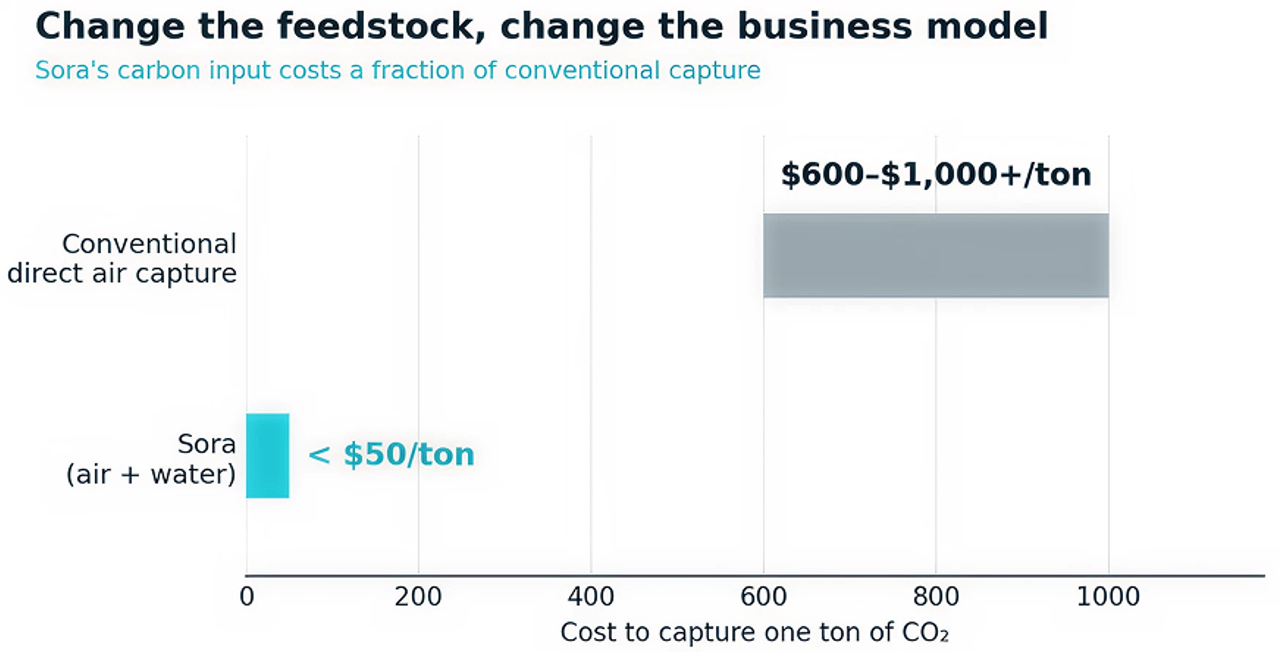
When the carbon input drops from $600–$1,000 a ton to under $50, the unit economics stop being a rounding problem and start being a different business. Data: Sora Fuel (April 2026).
The cooking-oil shortage is real, and it isn’t going away. The answer has been in the air all along.
1 "Sustainable aviation fuel likely to miss 2030 U.S. target," Earth.com, May 27, 2026. https://www.earth.com/news/sustainable-aviation-fuel-likely-to-miss-2030-u-s-target/
2 Kristin Brandt, quoted in Earth.com, May 27, 2026. https://www.earth.com/news/sustainable-aviation-fuel-likely-to-miss-2030-u-s-target/
3 "Disappointingly Slow Growth in SAF Production," IATA, December 10, 2024 — HEFA accounts for roughly 80% of near-term SAF capacity. https://www.iata.org/en/pressroom/2024-releases/2024-12-10-03/
4 K. Brandt et al., "Pragmatic assessment of meeting the 2030 U.S. sustainable aviation fuel goal," Biomass and Bioenergy (2026) — 2030 HEFA lipid demand of ~14.2 million t/yr versus ~10.2 million t of lipids used for all biofuels in 2022, requiring a ~54% increase. https://www.sciencedirect.com/science/article/pii/S0961953425009274
5 U.S. used cooking oil imports from China reached a record ~1.27 million metric tons (about 2.8 billion pounds) in 2024 — Time, “What Does Cooking Oil Have to Do With the U.S.–China Trade War?” (Oct. 2025): https://time.com/7325740/us-china-trade-war-trump-used-cooking-oil-uco-soybeans/. U.S. imports of animal fats, greases and processed oils surged to meet biomass-diesel demand — USDA Economic Research Service: https://www.ers.usda.gov/data-products/charts-of-note/chart-detail?chartId=109758. Europe imports roughly 80% of the used cooking oil it uses and consumes about eight times what it collects domestically — Transport & Environment: https://www.transportenvironment.org/articles/european-and-us-used-cooking-oil-demand-increasingly-unsustainable-analysis
6 R. Hanrahan, "EPA Investigating Used Cooking Oil Import Authenticity," Farm Policy News, 2024; cited in Brandt et al. (2026). https://farmpolicynews.illinois.edu/2024/08/epa-investigating-used-cooking-oil-import-authenticity/
7 Earth.com, May 27, 2026 — renewable diesel is often more profitable than SAF under current U.S. policy, diverting feedstock away from aviation. https://www.earth.com/news/sustainable-aviation-fuel-likely-to-miss-2030-u-s-target/
8 Project attrition (about half of announced projects never become operational) from Earth.com, May 27, 2026; mean ~4-year announcement-to-production timeline and ~1.5-year average delay from Brandt et al. (2026). https://www.earth.com/news/sustainable-aviation-fuel-likely-to-miss-2030-u-s-target/
9 "IATA Study Confirms that SAF Technology Rollout is Main Bottleneck to Net Zero, not Feedstock Availability," IATA, September 23, 2025. https://www.iata.org/en/pressroom/2025-releases/2025-09-23-01/
10 U.S. Gulf Coast kerosene-type jet fuel wholesale spot prices ran roughly $2–3/gal through 2024–2025 — U.S. Energy Information Administration: https://www.eia.gov/dnav/pet/hist/eer_epjk_pf4_rgc_dpgM.htm. HEFA/SAF production costs of roughly $4–6/gal, well above fossil jet — Watson et al., “Sustainable aviation fuel technologies, costs, emissions, policies, and markets: a critical review,” Journal of Cleaner Production (2024): https://www.sciencedirect.com/science/article/abs/pii/S095965262400920X
11 Conventional direct air capture for first-of-a-kind plants costs roughly $600–$1,000+ per ton of CO₂ — International Energy Agency, “Direct Air Capture”: https://www.iea.org/energy-system/carbon-capture-utilisation-and-storage/direct-air-capture. Sora’s stated capture cost of under $50/ton, via a closed-loop liquid (bi)carbonate electrolyzer on low-cost renewable power, is the company’s own figure: https://www.sorafuel.com/news/the-real-cost-of-saf-why-the-unit-economics-of-feedstock-will-decide-which-approach-replaces-fossil-fuels